


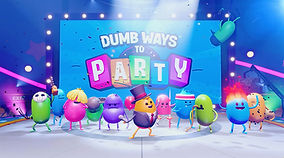
Dumb Ways To Party is a PC/Console multiplayer party game set in the Dumb Ways To Die universe. Players take part in Dumbest of the Dumb, a lethally over-the-top game show hosted by Duffa where danger and disaster is always just around the corner. Compete in game show challenges to earn wacky items, then bring them into mini-games to sabotage your rivals and earn points. Overcome the competition to prove once and for all who the dumbest bean truly is!
I first joined the team in February 2024 and took full ownership of the mini-games and character controller of the game, and worked closely with all the disciplines to prototype mechanics and mini-games for both local and online play. I later on became the lead of the content team, working closely with production and discipline leads on the development pipeline, asset lists and scheduled deliveries of over 40 mini-games from initial concepts to final polish.
Developer: PlaySide Studios
Platforms: Steam, Switch, Xbox Series X|S, PlayStation 5
Genre: Mini-Game Collection
Years Developed: 2024-2026
Roles:
-
Content Team Lead
-
Mini-Game Design
-
Systems Design
Software Used:
-
Unity
-
Fork/Gitlab
-
Confluence
-
Jira
-
Miro


.jpg)
Designing 40+ Mini-Games
I was responsible for the end-to-end design of all of the mini-games on Dumb Ways To Party. My process involved the identification of gaps and opportunities within our mini-game list that we wanted to fill, and from there creating initial concept log-lines. Once a concept was approved I fleshed them out into full feature specs in Confluence outlining the scope and assets we've need to create the mini-game, as well as the intended functionality and player experience. I'd review this with discipline leads to get buy-in, and then worked closely with the engineering team to prototype the concepts in-engine. As part of this I also collaborated with the engineers to iterate on the core player mechanics and movement to best serve the wider game experience.
Once a prototype's fun was proven, I worked closely with the other disciplines to flesh out the narrative and asset list to enhance the "dumb" of the experience, and took charge of the gameplay iteration as well as assisting the other disciplines in implementation of final art and polish. I also used Unity's Timelines extensively to block-out animations, camera shots and cinematics to introduce and conclude the scenario of each mini-game, as well as to lightly tutorialise mini-game objectives without the need for extensive instructions text.
Overall it was a fantastic learning experience, and as a long-time fan of Party games I had an absolute blast working and iterating on the mini-games!

I balanced the laser pattern variations within the mini-game, implementing escalating difficulty and fake-outs.
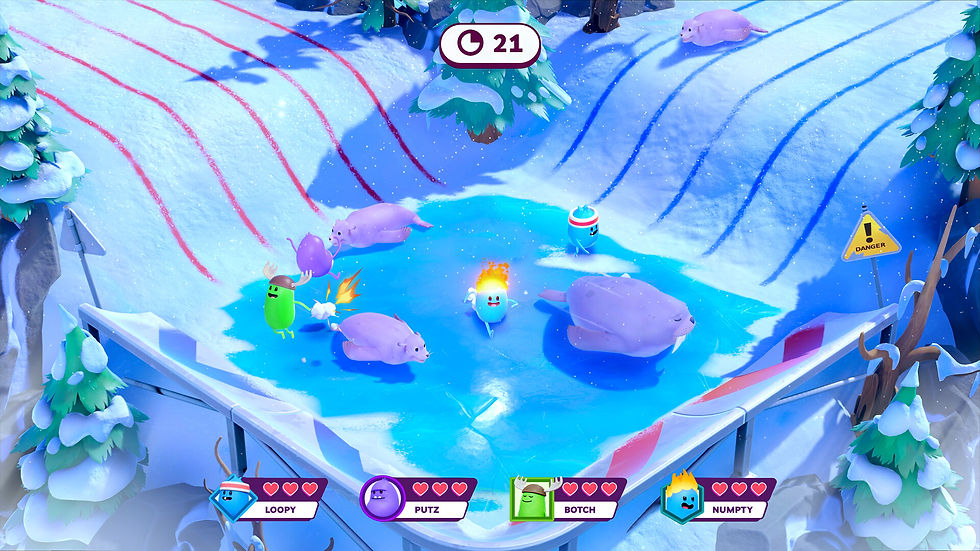
I balanced the slippery movement physics and implemented the obstacle pattern randomisation, with escalating difficulty based on the mini-game's duration.

I led the scenario design of this mini-game, working closely with the art and audio teams to amplify the suspense of eating takoyaki ball and the humour of accidentally eating the spicy one.
I balanced the laser pattern variations within the mini-game, implementing escalating difficulty and fake-outs.
Kick-Offs with the Content team
I later became a lead of the project's content team, working closely with production and project leads as an advocate for the mini-game design to organise the timeline for each development phase as well as the tasks and deliverables required for each. We also tested each mini-game rigorously as a committee to ensure they were meeting the requirements to move forward in development, and escalate any subsequent action items.
I also spearheaded collaboration processes in an effort to ensure each mini-game's vision was clear to the team and that everyone felt seen and included. I ran biweekly mini-game kick-offs with the team to outline the design of each mini-game to be worked on in the following sprint, as well as what work would be required from each discipline. I ran these as an open forum to allow team members to express any worries or concerns in advance, as well as to give any suggestions or ideas for mini-games. This lead to a really passionate and collaborative team environment, and getting to collaborate so closely with the team was always a real highlight of my sprint!