


Dumb Ways To Build is a PC/Console physics-based co-op game set in the Dumb Ways To Die universe. Create your own bean and form a construction crew to take on dangerous jobs across the city of Dumbville! Use a variety of chaotic constructions tools to build your way through the world, using whatever wacky materials you find along the way. Co-operate with your crew to overcome dumb dilemmas and workplace accidents to complete the day's work!
The project began life as a proof-of-concept prototype in which I lead a 6 person mini-team as part of a game jam initiative to come up with the next Dumb Ways project. Following a successful studio-wide playtest the prototype was selected for full production, with the full Dumb Ways team coming together again to develop it. I took responsibility for the iteration and refinement of the game's levels, as well as designing and balancing the game's tools, interactable objects and achievements system for unlocking cosmetics.
Developer: PlaySide Studios
Platforms: Steam, Xbox Series X|S, PlayStation 5
Genre: Physics-based Co-op
Years Developed: 2026
Roles:
-
Prototype Lead
-
Level Design
-
Systems Design
Software Used:
-
Unity
-
Fork/Gitlab
-
Confluence
-
Jira
-
Miro


Leading The Prototype
At the start of 2026 the Dumb Ways team was split into small multi-disciplinary mini-teams as part of a game jam initiative to prototype different concepts every week, with the end-goal being to bring one into full production. I took charge of one of these teams, directing the prototype that ultimately became Dumb Ways To Build.
My goal for the prototype was to create a strong set of mechanics to be tested in a playground environment, with the intent to expand on a game loop once we'd proven the fun. To achieve this I placed great importance on open and frequent communication with the team. I ran morning stand-ups to align the team on each day's deliverables, and end-of-day playtest sessions to assess the prototype's current state and create an action plan for the next day. Between these ceremonies I wrote design specs for the game's mechanics and features to ensure the team had what they needed to work undisrupted. I also prioritised the team's work based on what was needed for the most viable product (MVP) vs. nice-to-have if we had extra time, and worked in-engine to support the team in implementing and balancing content.
We received positive reception from the Dumb Ways team at the end of the week, and afterwards were assigned another week to create several modes to test what type of game loop synergised best with our mechanics. The results would be playtested end-of-week by the wider studio alongside the other mini-team's prototypes. I worked closely with my team to brainstorm modes varying widely in objective and intensity (e.g. survival-themed, puzzle-themed), with the intent to cast a wide net what data we'd obtain from the playtest around the game loop. I assigned each team member a mode to take responsibility for, and we touched base regularly to share cross-mode functionality to support one another. By the end of the week we achieved three core mode types, each with several level variations to prove scalability.
After the studio-wide playtest, all employees were asked to complete a survey assessing each team's prototype and which one they felt had the most potential as a full product. Ultimately my team's prototype got the most votes from the survey and was greenlit for full production, with the full Dumb Ways team coming back together to work on it. The prototype itself proved to be a great mechanical foundation to reference for the final product, and the playtest data obtained from each prototyped mode was instrumental in guiding the final direction of the game's core loop.

Iteration of an Interactive World
The development timeline for Build was very quick, meaning we had limited time to iterate on each level. To achieve this we had one team work on the initial prototype of a level, before passing it onto my team to refine and polish. I leveraged playtest data to triage feedback and develop action plans for what improvements we could achieve in each level in the allotted time, working closely with discipline leads to create tasks and priorities for the team. I then worked closely with the artists and engineers to implement final art and functionality into each level, frequently playtesting the game and rapidly iterating on the balancing and object availability as I went.
Another of my goals as part of level refinement was to identify and implement opportunities for extra interactivity in the world, with much of the game's humour coming from tool mishaps leading to disaster and destruction. I worked closely with the design team to categorise common interactions, which we then passed onto engineering to create tooling allowing us to easily implement interaction behaviours. This resulted in levels where the tools actually feel meaningful and interactive, whether it be breaking apart structures to use their parts to build with or finding silly easter eggs from shaking down a tree. I'm particularly proud of how this factored into the lobby which embodied the playground experience we sought to create in the initial prototype with the sheer interactivity possible, doubling as emergent tutorialisation of mechanics and tools before actually playing the levels.
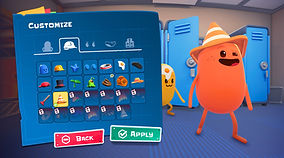
Playful Achievements Rewarding Dumbness
Like other games in the co-op genre (e.g. PEAK), Build has achievements that unlock cosmetics to customise your player character. As a passionate achievement hunter, I was ecstatic for the opportunity to take on the design for Build's achievements and cosmetic unlock system. My goal was to promote replayability of each level, tutorialise each tool's mechanics, and reward the player for dumb interactions with both the levels and their friends. I also wanted to lean heavily into dumb humour for each achievement, usingpuns and references to the classic song in writing up the names and descriptions.
I categorised achievements based on whether they were tool or level-based. Each tool had a couple of achievements centred around its core functionality, as well as interaction with other players. For each level, I took inspiration from 3D collectathons (e.g. Super Mario 64) to create recurring archetypes for ease of set-up. This included standard level-completion sets based on difficulty and completion time, as well as sillier level-specific interactions centred around photography, destruction and level-specific workplace accidents resulting in death.
I also leaned heavily into humour and irony where possible when assigning the cosmetic unlocked per achievement, while ensuring the effort put into completing each achievement matched the quality of the reward. Quick and silly interactions earn simpler cosmetics (e.g. taking a selfie in a mirror unlocks a duck-face mouth), while death-related achievements earn cosmetics related to the death (e.g. getting hit by a car unlocks a traffic cone hat). More difficult achievements unlock more extravagant cosmetics, a prime example being the flaming head being obtained by reigniting the Skyscraper statue's torch by using yourself as a lightning rod.